Showing posts with label Listening. Show all posts

English for Babies and Parents

Note to parents: Learn English with your baby. All underlined words are explained in EnglishChecker. To listen to audio, click the green arrow twice.
Welcome to these English for Babies and Parents pages, where you and your baby can practise English together. Here you will find simple stories, rhymes, games and recommended materials to help you introduce English to your baby or toddler. The audio sections will help you learn the songs and rhymes so that you can teach them to your baby.
Native English parents may also use these pages with their young children. Browse through the lessons to find songs, rhymes, and activities to use throughout the day as your child learns her native language.

Frequently Asked Questions

Is my baby too young to learn English?

It is never too early to introduce English to your baby. Babies love sounds, rhymes, and stories. Learning a language comes naturally to them. Most experts agree that babyhood is the best time to learn a second language. From birth to about age two or three, your baby's brain acts like a sponge. This is also the best time for a parent to teach a language. Parents and other adults naturally speak more slowly and clearly to babies than older children. They also tend to repeat words and phrases often. Repetition is very important for language learning.

How will my baby learn English?

Babies learn languages in many ways. Most importantly, they learn through listening. The more words they hear, the more words they learn. They also learn from watching and imitating. While you play together, your baby will learn to associate words with objects. English Club will help you introduce your baby to English through songs, rhymes, and playtime.

How long should we practise?

Baby wearing backpack Make English part of your daily routine. Sing, read, and play with your baby in English whenever you think of it. Recite a rhyme on the diaper table, sing a song in the bath, and read a bedtime story. Think of teaching English as part of your playtime not as a lesson. Babies tell us when they are tired, bored or hungry. Watch for cues. When your baby rubs her eyes, cries, or crawls away, she is probably ready for a new activity. It is important not to overstimulate a baby.

Will my baby get confused about her first language?

Many parents fear they will confuse their babies by introducing two languages. Research shows that babies can learn more than one language at a time. In bilingual homes, many parents use a method where one parent speaks one language and another parent speaks another language. Sometimes they choose a language that will be the "native" language, though children will make their own decisions, based on the one they hear more often. You should do whatever feels most natural to you. Interacting with your baby early on in both languages is the key. Never let a television take the place of a human.

Why isn't my baby talking?

Experts believe that babies understand language about 6 months before they can express their understanding. Your baby is mainly listening to sounds and words. When you talk, read, and sing to your baby, he will listen and smile. One day your baby will surprise you. She will sing along with you or point to an item and say the proper word. Then you will know that she was listening! Never compare your baby with other babies. Children learn at their own pace. It is unfair to have learning expectations at this age. Keep in mind that babies are learning many things at once. When your baby starts to walk he may stop talking for a while. This doesn't mean you should stop singing and reading to him! Visit here for more Beginner's tips.

Will my baby learn my English mistakes?

Don't worry if your English isn't strong. You are still the best teacher! Babies love the sounds of their parents' voices. These pages are designed for beginners. You and your baby can learn together.
Mom and baby playing EnglishChecker
enjoy:
like
introduce:
begin
natural:
something you are born with
overstimulate:
confuse or cause anxiety by introducing too many activities or objects
repetition:
read or say over and over again
confuse:
cause learning trouble
sponge:
a soft material that can absorb a lot of water
READMORE - English for Babies and Parents

How To Learn English

Tips and ideas on the best ways to learn English faster.

Tips for Beginners

  1. You are like a new baby
    Babies learn their language slowly.
    First they learn to listen.
    Then they learn to talk.
    Finally, they can read and write.
  2. Listen to English every day
    Listen to English radio.
    Watch English TV.
    Go to English movies.
    Use online lessons.
  3. Make an English/ESL friend
    Make up conversations.
    Practise dialogues.
    Use beginner textbooks.
  4. Read English stories
    Start with children's storybooks.
    Try ESL readers.
    Read advertisements, signs and labels.
    Try EnglishClub.com for Young Learners.
  5. Write down new words
    Start a vocabulary (new word) notebook.
    Write words in alphabetical order (A...B...C...).
    Make example sentences.
    Always use an English-English dictionary first.
  6. Keep an English diary
    Start with one sentence.
    How do you feel?
    How is the weather?
    What did you do today?
    Write another sentence tomorrow.
  7. Visit an English speaking country
    Learn English more quickly.
    Stay with an English family.
    Hear native speakers talk.
    Have a fun experience.
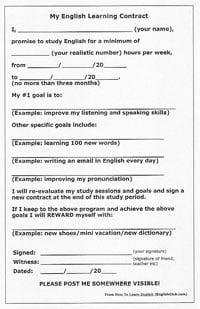
My English Learning Contract

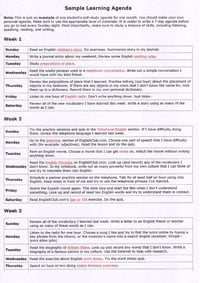
Sample Learning Agenda

Where do I start?

Why do you want to learn English?
Before you begin (or go back to) studying English, ask youself one question. Why do I want to study English? Is it because you want to, or because someone else wants you to? Like every decision in life, studying English must be something you want to do.


Set goals
If you know why you want to study, setting goals is easy. For example, maybe you want to travel to an English-speaking country. Great. Your goal might be to learn "Survival English". Perhaps you already know many useful phrases, but you want to improve your listening skills and pronunciation. Whatever your goals are, write them down.


Make an agenda
How long do you need to study to achieve your goals? This answer is different for every student. The important thing is to be realistic. If you work 60 hours per week, don't plan on spending another 40 hours a week studying English. Start off slow, but study regularly. Use material that is challenging, but not too difficult. Find out what works for you. After you have studied for a few weeks, adjust your study schedule accordingly. Do you study best at night, or on the bus on your way to work? Do you like to study alone in a quiet place, or with friends and background music?


Make a commitment
Learning English requires a lot of motivation. Nobody is going to take your attendance when you aren't in class. If you are sure you are ready to begin studying, make a commitment. 


Have fun learning English!
The things we do best in life are the things we enjoy doing. If you aren't having fun learning English, you're not studying the right way! You can be a serious student who has fun at the same time. Make up your own rewards program to give yourself incentives to stay on task.

Study a Balance of the 4 Key Skills
(Listening, Speaking, Reading, Writing)

Most students want to communicate better in English. If this is one of your goals, it is important to study a balance of the four major skills. Listening, Speaking, Reading and Writing are the main (macro) skills you need to communicate in any language. Being very good at only one of these skills will not help you to communicate. For example you need to be able to read well before you can write well. You also need to be able to listen before you can speak. It helps to think of these communicative skills in two groups.
  • INput <<<
    • Listening (in through your ears)
    • Reading (in through your eyes)

  • OUTput >>>
    • Speaking (out through your mouth)
    • Writing (out through your hand)
It's simple. Think of it this way. First you have input. Next you have output. First you listen to someone ask you a question. Second you speak and give them your answer. First you read a letter from someone. After that you write back to them. These are examples of communicating.
Input and output don't necessarily go in a specific order. Sometimes you speak first and then you listen. Sometimes you write about something you hear. During communication, the person you are communicating with uses one of the opposite skills. Therefore, in order to understand each other, everyone must be skillful in all four areas.
Some students want to know which skill is the most important. Since all of the skills rely on each other, they are all important. However, to communicate we do use some skills more often than others. For example, about 40% of the time that we spend communicating we are simply listening. We speak for about 35% of the time. Approximately 16% of communication comes from reading, and about 9% from writing. These statistics are for an average communicator in English. Depending on someone's job or situation, these numbers may vary.
Each of these main skills have micro skills within them. For example, pronunciation is a type of speaking skill that must be practised in order to improve communication. Spelling is a skill that makes understanding the written word easier. Grammar and vocabulary are other micro skills. Micro doesn't mean they are unimportant. Macro skills such as listening are very general, while micro skills are more specific. (More about input and output)
For the best results, create an agenda that combines all four areas of study. Allow one type of studying to lead into another. For example, read a story and then talk about it with a friend. Watch a movie and then write about it. This is what teachers in an English class would have you do, right? EnglishClub.com has lessons in all 4 key skills (and all minor skills), as well as many outside links to help you study further. (ESL Internet resources)

1. How to learn LISTENING

  • Listen to the radio
    Don't always have a pen in hand. Sometimes it helps to just listen.
  • Watch English TV
    Children's programming is very useful for ESL learners.
    Choose programs that you would enjoy in your own language.
    Remember that much of what you hear on TV is slang.
  • Call Automated Answering Machine recordings
    You can find these numbers at the front of telephone books in many English-speaking countries. Before you dial, make sure that you are calling the free numbers.
  • Watch movies
    Choose ones with subtitles, or one from ESLNotes.com (provides useful notes on popular movies).
  • Use Internet listening resources
    Every day there are more and more places to listen to English online.

2. How to learn SPEAKING and pronunciation

  • Talk to yourself
    Talk about anything and everything. Do it in the privacy of your own home. If you can't do this at first, try reading out loud until you feel comfortable hearing your own voice in English.
  • Record your own voice
    This might feel very uncomfortable, but it will help you find your weak pronunciation points. Listen to yourself a few days later. Which sounds do you have difficulty hearing?
  • Use the telephone.
  • Participate in class
  • Learn common idioms
  • Understand the sounds that your language doesn't have
    For example, many languages don't have the "r" sound. These sounds require extra practice.
  • Recognize that teachers are trained to understand you
    When you get out into the real world, average people will have a more difficult time understanding you unless you practise speaking slowly and with proper pronunciation.
  • Practise minimal pairs
  • Study word and sentence stress
  • Practice tongue twisters

3. How to learn READING and vocabulary

  • Read something every day
    Children's books, simplified readers (Penguin), newspapers, magazines, Internet sites, novels, and much much more...
  • Read what interests you.
    Remember that you learn better when you are having fun.
  • Read at the appropriate level
    You want to learn new vocabulary, but you also want to understand what you are reading. If you are looking up every word, the reading is too difficult.
  • Review Who, What, Where, When, Why for each story you read
    You can do this for almost any type of reading. Who is it about? What happened? Why did it happen? Where did it take place? When did it take place? This is very useful when you have no comprehension questions to answer. You can write or speak your answers.
  • Always have an English-English dictionary nearby
    It is a bad habit to always rely on a translation dictionary or electronic dictionary.
    Think of your English-English dictionary as your life line.
    Use online dictionaries when you are using the Internet (keyword online dictionary).
  • Record vocabulary in a personal dictionary
    • Keep this notebook separate from other work
    • Record vocabulary in alphabetical order (an English address book works well because it has letters of the alphabet)
    • Record the part of speech (sometimes there is more than one)
    • Write a sample sentence for yourself (don't use the one from the dictionary)
    • Review your personal dictionary (especially new entries) every night before bed

4. How to learn WRITING and spelling

  • Keep a diary/journal
    Don't always pay attention to grammar. Free-writing can be very useful. It can show you that writing is fun. Have fun with the language.
  • Write emails in English
    Stay in contact with teachers or other students.
  • Rewrite your local news in English
    This is another exercise that can be done on a daily basis. Remember that regular activities are the best ones.
  • Learn important spelling rules
    Remember, you won't always have a dictionary or a spell-checker handy, especially when you are writing a test. Even native English speakers need to review the spelling rules from time to time.

More TIPS for learning English

Don't be afraid of grammar

  • Grammar is for communication
    Sometimes students get obsessed with grammar. This is especially true for students who grew up with strict grammar schooling. Remember that you only study grammar in order to communicate. Practise with a few exercises, then write an essay or have a conversation and try to use your new tools.
  • Isolate your weak points
    Don't waste time on grammar exercises that you already understand just because they are easier for you. Concentrate on grammar that is difficult for you. If you are unsure of where your problems are, write a few short essays or paragraphs and ask a teacher to circle repeated errors. Then you can look up your problem and practise it.
  • Teach grammar points to a friend
    Find a friend who studies at a lower level than you. Teaching will force you to remember the rules and to understand them properly. Try preparing a worksheet for your friend.

Improve your homework skills

  • Stay organized. Keep separate notebooks for exercises, writing, and vocabulary.
  • Use a pen that you love.
  • Study in short, regular periods.
  • Allow a short amount of time for review.
  • Study in a place where you feel happy and comfortable.
  • Don't allow distractions. Consider email, TV, and the telephone (unless in English) off limits while you are studying.
  • Have a drink and snack handy so that you don't have to get up.
  • If you study in pairs or groups, make an English-only rule.

Visit an English-Speaking Country

  • Take a language holiday.
  • Stay with a homestay family.
  • Learn from native English teachers.
  • Gain access to English culture.
  • Get a part-time job.
  • Volunteer.
  • Make native English friends.
  • Make friends with people from other countries.
  • Become more confident.
  • Hire a tutor.
  • Offer language lessons/swap in your own native tongue.

Prepare for a standardized test such as TOEIC or TOEFL

  • Qualify for a better job in your country (TOEIC).
  • Get accepted to an American college or university (TOEFL).
  • Use guided-study text books.
  • Study a broad range of whole language.
  • Track your improvement easily (test scores).
  • Learn idiomatic language.
  • Learn business English (TOEIC).
  • Improve your vocabulary quickly.
  • Take classes and get access to many listening exercises.
  • Challenge yourself to improve your score.
  • Learn and practise proper essay format (TWE/NEW TOEFL).
  • Become a grammar expert.
  • Improve your general knowledge.

Fun with English Ideas

  • Have an English-only evening once a week. Cook in English (rewrite your recipe in English) or watch English movies.
  • Write an English love letter. (If your loved one doesn't understand English that's even better!)
  • Write English limericks. (These are excellent and simple for writing, pronunciation and rhythm practice.)
  • Rewrite fairytales, jokes or instructions in English.
  • Go out and pretend you don't understand your native language (try to get by in only English).
  • Go online and find the lyrics to your favourite English songs and sing along to them (use a search engine).
  • Learn the words to English national anthems. Sing along when you hear them on TV (sporting events).
  • Invent an English character for yourself (with job, family, etc). Write this person's biography.
  • Buy an English board game (like Monopoly or Scrabble).
  • Play cards in English.
  • Start up or join an English reading or conversation club.
  • Talk to yourself in English while you clean or do the dishes.
  • Go around the house and try to name everything in English (furniture, clothes etc). Look up words you don't know.
READMORE - How To Learn English

How to Hear English Everywhere

Two simple definitions
  • to hear: to receive sound with the ears
  • to listen: to try to hear
You are very good at languages. That's obvious, because you already speak one language very well - your own! And if you can learn and speak one language well, then you can certainly learn and speak one or more other languages.
But did you ever ask yourself: "How did I learn my own language?" In fact, you never really "learned" it at all - you just started speaking it. One day, when you were about two or three years old, you started speaking your language. A few words at first, not full sentences. But you spoke. And very soon you made progress without even thinking about it. It was like magic!
But it wasn't magic. It was the result of hearing. For two to three years before you spoke, you heard people speaking your language all day, and maybe all night. You heard people speaking your language. Maybe you listened to people, but more importantly you heard. them. Then, as if by magic, you started to speak. All that hearing was necessary for you to start speaking. For two to three years words went IN to your head. Then words came OUT of your head! That is why hearing (and listening to) English as much as possible is so important to you now. The more English you put in, the more you'll get out!
So how can you hear a lot of English when you're not in an English-speaking country or family? Fortunately, there are many ways of hearing English in almost all countries of the world.

Radio

You can receive English language radio in most countries. Two of the best international networks are the BBC World Service and Voice of America. Both of them have special programmes for learners of English. You can find information about times and frequencies for your country on their web sites. Click here for links to radio stations.

Television

TV is an excellent resource for hearing and listening to English. The pictures help you understand what is being said. If you don't have access to English-language TV, you may be able to watch TV on Internet.

Internet

It is now a lot easier to hear English by Internet. If you're reading this at your computer, you can probably listen to some English-language radio news right now, without even moving! To be able to listen to radio on the Internet, you'll need to have special software called a "player" installed in your computer. Most sites work with two players - the RealPlayer from RealNetworks and the Windows Media Player from Microsoft. Don't worry. Both these players are free and you may already have them installed on your computer.

Music/songs

Songs in English are everywhere, even on foreign-language radio and TV stations. Listen to them often. Buy some cassettes or CDs, or make recordings, and try to write the words for an entire song. But choose one that is not too difficult. That means it should be reasonably slow, and with real words sung clearly. Some pop songs are very unclear and are difficult even for native English-speakers to understand fully!

Cinema

Outside the English-speaking world, many large cities have cinemas that show films in English, usually with sub-titles. Make it a habit to go to these films. If you need to read the sub-titles, at least you'll be hearing English even if you don't understand it.

Video

Video has one really great advantage. You can play it again . . . and again. You can use video to watch film cassettes that you buy or borrow. If there are sub-titles, you can cover them with paper (which you can remove if you really don't understand after listening several times). And you can use video to record programmes from television and then watch them several times to improve your understanding.

Friends

Try to make friends with English-speaking people so that you can practise your English through conversation. Of course, this will practise your speaking as well as your listening. And if you don't have a lot of time to go out and meet people, at least you can chat a little by telephone.
Finally, don't worry if you don't understand everything you hear. Hearing comes first! Understanding comes next!
READMORE - How to Hear English Everywhere
Related Posts Plugin for WordPress, Blogger...

Popular Posts